#074: You Are Abraham's Heir. Start Acting Like It. 👑


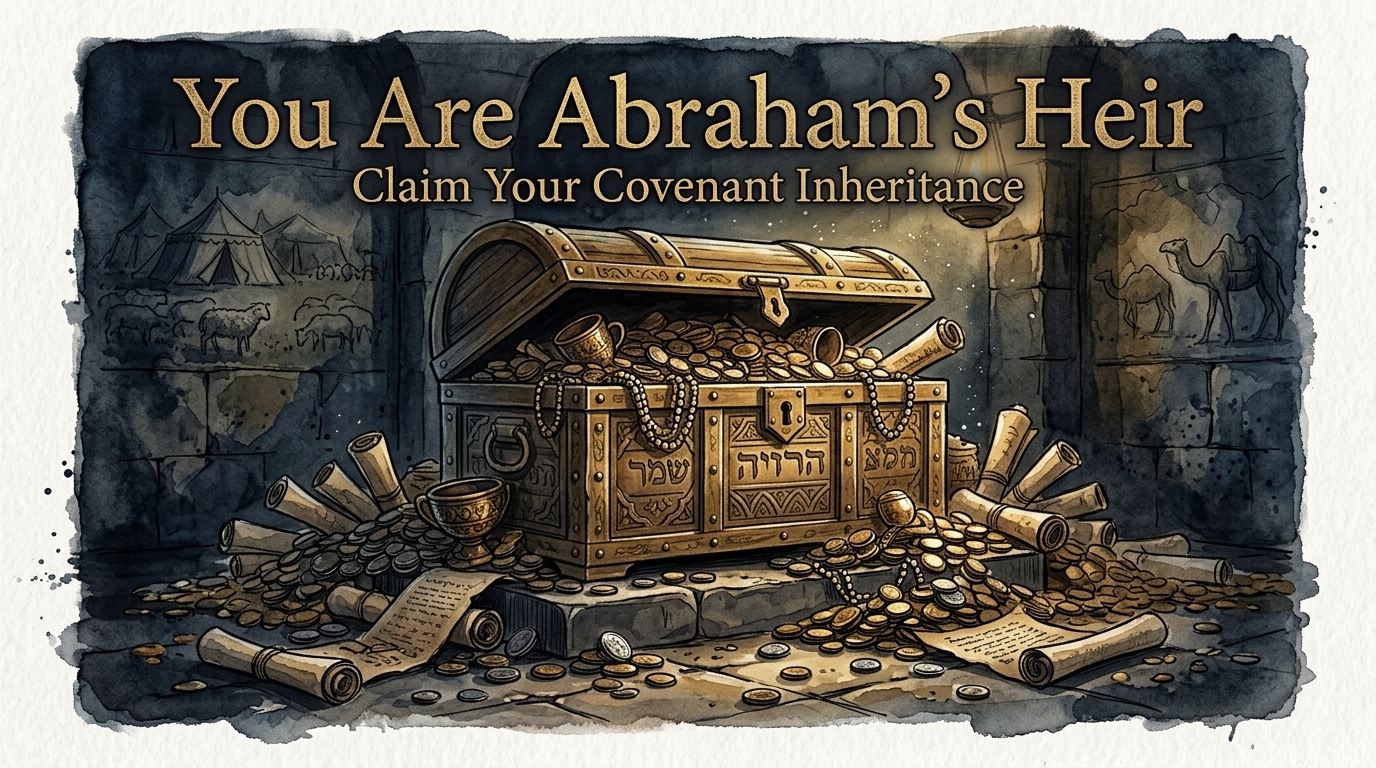
Galatians 3:29 says if you are in Christ, you are Abraham's seed and heir according to the promise. Abraham was rich in silver and gold. Read that again.
Welcome, Family
Last week: the serpent came back. We named what is actually happening to this generation.
This week: The Covenant Inheritance. Because before the enemy can rob you of your future, he has to convince you it was never yours to begin with.
And the church has been helping him do exactly that.
The Poverty Theology Problem
There is a version of Christian teaching that has produced more financial guilt, more self-sabotage, and more covenant violation than almost anything else in modern church culture.
It sounds humble. It uses scripture. It positions itself as a safeguard against greed and materialism. And it has convinced an entire generation of believers that prosperity is suspicious, that financial ambition is worldly, and that struggling is somehow closer to Jesus than thriving.
It is wrong. Theologically, historically, and covenantally wrong.
Not because money is the point. Money is never the point. But because the same God who said seek first the kingdom also said all these things will be added. And He meant it. Both parts.
“And if ye be Christ’s, then are ye Abraham’s seed, and heirs according to the promise.”
- Galatians 3:29 (KJV)
If you are in Christ, you are Abraham’s legal heir. Not a spiritual metaphor. A legal reality. And Abraham was not spiritually rich. He was not rich in contentment. Genesis 13:2 is specific and deliberate: Abraham was very rich in cattle, in silver, and in gold.
The Bible lists the physical assets on purpose. So that nobody could spiritualize their way out of what it was actually saying.
What the Camel Was Really About
Matthew 19 is the passage that has done the most damage. The one with the camel and the needle. The one that gets preached as a warning against financial prosperity and has sent generations of believers into a guilt spiral every time they started making real money.
Here is what Jesus was actually saying.
Matthew 19 is not primarily about the Rich Young Ruler. It is a deliberate contrast between two groups of people who came to Jesus in the same chapter. Little children, who were completely dependent, brought to Jesus by others, unable to contribute anything to their own salvation. And the Rich Young Ruler, self-reliant, self-righteous, asking what good thing he could do to earn eternal life.
Jesus exposed him. The man claimed to have kept every commandment since youth. Jesus looked at his clothes, his shoes, his chariot, and the poverty of his neighbors and knew he was lying to His face. The command to sell everything was not a universal principle about wealth. It was an individual prescription designed to expose one man’s specific idol: his self-righteousness.
“With men this is impossible; but with God all things are possible.”
- Matthew 19:26 (KJV)
The camel cannot fit through the needle. Neither can human self-righteousness earn salvation. That is what Jesus was saying. Not that bank accounts disqualify you from heaven.
The disciples were confused for exactly the right reason. They knew Abraham, Isaac, Jacob, and David were all exceedingly wealthy. If material prosperity barred entry into heaven, the patriarchs were condemned. Which would contradict every promise God ever made. Which God does not do.
The Greek word translated as “rich” in Matthew 19:23 is plousios, used figuratively to mean rich in self-righteousness. The man who is so full of his own goodness that he has no room to receive God’s. That man cannot enter the kingdom. Not because of his money. Because of his self-sufficiency.
The Covenant Pipeline
Here is the framework that changes everything.
God made a covenant with Abraham in Genesis 12. He promised to bless Abraham and make him a blessing. He promised that through Abraham’s seed all nations would be blessed. He delivered on that promise materially, visibly, and specifically.
Then Jesus came as the fulfillment of that seed. And Galatians 3 makes the application explicit:
“For ye are all the children of God by faith in Christ Jesus. For as many of you as have been baptized into Christ have put on Christ… And if ye be Christ’s, then are ye Abraham’s seed, and heirs according to the promise.”
- Galatians 3:26-27, 29 (KJV)
The covenant pipeline runs from Abraham through Christ to every believer. You did not enter a new covenant that replaced the financial promises. You were grafted into the root system that already carried them.
Which means the blessing of Abraham is your birthright. Not a bonus for exceptional faith. Not a reward for enough prayer and fasting. A legal inheritance that belongs to you because of whose you are.
Three things this covenant changes:
How You See Prosperity
Prosperity is not the enemy of faith. It is a design feature of kingdom citizenship. God placed gold in the Garden of Eden before He placed people in it. He called it good: the eighth time He used that word in all of scripture, the number of abundance and new beginnings. Wealth was in the environment before the tenants arrived.
When you feel guilty about financial success, you are not being humble. You are disagreeing with your inheritance. Those are not the same thing.
How You See Struggle
Financial struggle is not evidence of holiness. It is evidence that something in the covenant pipeline is blocked. The block might be in your belief system: a poverty theology that has been accepted as doctrine. It might be in your practice: the principles of the covenant not yet applied. It might be in your preparation: a season of equipping before the release.
But struggling is never the design. It was the consequence of the fall. And Jesus came to restore what the fall destroyed.
How You See Your Assignment
Every believer has a specific assignment. A territory. A realm over which they have been made a steward. And that assignment comes with provision. Not because you earned it. Because the King funds His own assignments.
Joseph understood this. His path went through a pit, slavery, and prison before it reached the palace. But every stop was curriculum. Every hardship built the specific capacity the assignment required. And when he finally stood in his position, the resources of an entire nation flowed through him.
He didn’t give grain away. He sold it. Proverbs 11:26 says the blessing rests on the head of the one who sells. Joseph consolidated currency, livestock, real estate, and labor for Pharaoh during a famine because he understood that his assignment required him to operate at the level the assignment demanded.
Your assignment is no different. The question is whether you are operating at the level it requires.
What Have You Got in the House?
The widow in 2 Kings 4 thought she had nothing. Creditors were coming for her sons. Everything was gone. She came to Elisha with an empty report.
Elisha asked two questions. What shall I do for you? And: what do you have in the house?
She almost dismissed it. She had nothing. Just a little oil.
That little oil, the thing she was ready to overlook, the asset she had discounted so completely she nearly left it out of her answer, was the exact provision needed to pay every debt and secure her family’s future.
Most believers are sitting on their oil calling it nothing.
The skill God developed in you during your hardest season. The insight that came from your most painful experience. The gift that feels so natural to you that you can’t imagine anyone paying for it. The lesson you lived through that someone else desperately needs to hear.
That is your oil. And the question Elisha asked is the question God is asking you right now.
What do you have in the house?
Not what do you wish you had. Not what everyone else has. What did God put in you (specifically, deliberately, irreplaceably) for this assignment?
Find it. Extract it. Sell it. That is not greed. That is stewardship of a covenant inheritance.
Prayer Corner
“Father, we confess we have been living like spiritual orphans when You signed our name to a covenant.
We called our poverty humility. We called our financial guilt holiness. We agreed with a theology that You never authored and used it to stay exactly where the enemy needed us to stay.
Forgive us. We are Abraham’s seed and heirs according to the promise. That promise was always meant to be material and visible, not just spiritual and metaphorical.
Show us what is in our house. Show us the oil we have been overlooking. Give us the courage to extract it, develop it, and deploy it at the level our assignment requires.
We receive the inheritance today. Not to hoard it. To demonstrate it. Not to worship it. To deploy it for the King.
Amen.”
Join Us This Week
🙏 Virtual Prayer Meeting
Wednesday, Sep 30 | 7:45-9:00 PM ET
Join Live
📖 Virtual Bible Study
Friday, Oct 2 | 8:00-10:00 PM ET
Join Live
Follow @mogakaeventsministry for the message of Christ.
In His Love,
Ravi Patel & Chriss Mogaka
Mogaka Events Ministry
Don't miss the next post
We send one email a week with thoughts like this, plus upcoming event details.
Welcome to the family!
We just sent your welcome email. Check your inbox (and spam or promotions folder) right now to get plugged in!